Introduction
Lineage in Chen Tai Chi isn’t just about tradition or prestige—it’s about accuracy, depth, and integrity of the art. In Chen style especially, lineage plays a much bigger role than in many other martial arts because so much of the system is subtle, internal, and easily lost or diluted.
A true lineage ensures:
Movements are taught as originally intended
Internal principles (not just choreography) are preserved
Key methods like silk reeling (chan si jin) aren’t lost
Although the theory of yin and yang (Tai chi ) is a few thousand years old and as a concept has been applied to everything from traditional Chinese medicine, Taoism, Feng Shui ,etc, the actual martial art we know as Tai Chi Chuan (Taijiquan) was formulated a few hundred years ago by the Chen family in Henan Province which is today famous for its martial arts schools and is also the birthplace of Shaolin Gongfu.
There are said to be up to 10,000 martial arts schools in Henan alone making it the mecca of Chinese martial arts.
Here is the story of how Tai Chi Chuan began with a family called Chen.
Chen Family History
Chen Bu (陳仆; 陈卜) was a skilled martial artist who started the martial arts tradition within Chen Village. The Chen family were originally from Shanxi, Hong Dong (山西洪洞). Chen Bu, considered to be the founder of the village, moved from Shanxi to Wen County, Henan Province (河南溫县) in 1374.
The new area was originally known as Chang Yang Cun (常陽村) or Sunshine village and grew to include a large number of Chen descendants. Because of the three deep ravines (Gou) beside the village it came to be known as Chen Jia Gou (陳家溝) or Chen Family creek/brook.
For generations onwards, the Chen Village was known for their martial arts. The special nature of Tai Chi Chuan practice was attributed to the ninth generation Chen Village leader, Chen Wang ting (陳王廷; 陈王庭; 1580–1660).
He codified preexisting Chen training practice into of seven routines. This included five routines of Tai chi chuan (太極拳五路), 108 form Long Fist (一百零八勢長拳)and a more rigorous routine known as Cannon Fist (炮捶一路).
Chen Wang ting integrated different elements of Chinese philosophy into the martial arts training to create a new approach that we now recognize as the internal martial arts.
He added the principles of Yin-Yang theory (the universal principle of complementary opposites), the techniques of Doayin (leading and guiding energy) and Tu-na (expelling and drawing energy), theories encountered in Traditional Chinese Medicine and described in such texts as the Huang Di Nei Jing(《黃帝內經》; Yellow Emperor’s Canon of Chinese Medicine).
In addition, Wang ting incorporated the boxing theories from sixteen different martial art styles as described in the classic text, Ji Xiao Xin Shu(繼效新書; “New Book Recording Effective Techniques”; ~ 1559-1561) written by the Ming General Qi Jiguang (戚繼光; 1528–1588).
Chen Changxing (陳長興 Chén Chángxīng, Ch’en Chang-hsing, 1771–1853), 14th generation Chen Village martial artist, synthesized Chen Wangting’s open fist training corpus into two routines that came to be known as “Old Frame” (老架; lao jia).
Those two routines are named individually as the First Form (Yilu; 一路) and the Second Form (Erlu; 二路, more commonly known as the Cannon Fist 炮捶).
Chen Changxing, contrary to Chen family tradition, also took the first recorded non-family member as a disciple, Yang Lu-Chan (1799–1871), who went on to popularize the art throughout China, but as his own family tradition known as Yang Style Tai Chi Chuan.
Chen Zheng Lei
Chen Zheng-Lei was born in May 1949 in Chenjiagou Village. The son of Chen Zhao-Hai (who died a year after his son was born), he has been practicing Chen style Taijiquan for over forty years. His teachers include the famed masters Chen Zhao-Pi (with whom he lived and trained) and Chen Zhao-Kui (both his uncles), masters of the 18th generation in Chenjiagou.
He is known as “Taiji Jingang” – and regarded with Chen Xiao Wang ,his cousin to have the highest level skill of his generation in Chenjiagou. He was twice the Taijiquan Grand Champion at the National Taijiquan Competitions, and has won over 10 gold medals at the Henan Martial Arts Competition.
In 1987 he was selected as a National Martial Arts First Class Judge, and his team won three team first places from 1989 to 1991 at the National and Henan Martial Arts Meets. He has trained many great athletes, among them the celebrated champion Master Wang Hai Jun and Ding Jie. In 1995 he was awarded the title of Da Shi [da shr] or Grand master.
Grand master Chen is the author of Chen Shi Taijiquan Xie Hui Zong (Comprehensive Taijiquan Boxing and Weapons Manual) and, “Taijiquan Nei Qi Qian Tan Yu Jing Luo Xue Shuo” (A Discussion of Internal Energy in Taijiquan and Theory of the Main and Collateral Energy Channels in the Human Body) among others. He is the author of instructional videotapes dealing with Lao jia, Xin jia, Push Hands, Weapons and Qigong.
Grand master Chen is in great demand both in China and abroad as an instructor. He has trained over 15 of the coaches for the Beijing and Wuhan Physical Education Institutes, and is an adviser to Taiji organizations in Japan, France, America, and Italy. Grand master Chen runs a school in Zhengzhou City, Henan Province, China and runs an international summer camp every August there. His first disciple Master Wang Hai Jun also teaches there when he is available and is sought after in great demand.
Grand master Chen continues to teach and lecture even though he has officially retired and is admired for his leadership skills and efforts to make Taiji´s ancient and subtle concepts understood by the Western mind.
Wang Hai Jun
Master Wang Hai-Jun was born Jan. 1972 in Zhengzhou city in Henan province. At the age of nine his father arranged for him to move to Chen Village to live and study with Grand master Chen Zhenglei. Each day before school he would train from five to seven thirty in the morning. After school he would train from four until six, frequently training again in the evening for another two hours before going to bed.
In the autumn of 1988, he gained entry to the Wuhan Physical Culture University, one of the top universities of its kind in China. He competed successfully for his university in many competitions. After graduation Master Wang Hai-Jun was assigned to the post of coach of Pingdingshan Wushu Research and Study College.
He is a senior state Wushu referee, the president and head coach of Zhengzhou Wushu Research and Study College, and coach of Henan Chen Zhenglei Taiji Culture Co., Ltd.
He is an official lineage holder of Chen Style Taiji (12th generation Chen Taiji).
He has an extensive list of accomplishments in competition. In 1992 he won three gold medals in national competition, and won the championship in push-hands at the National Taiji Boxing, Sword and Push-hands Competition. In 1994 he won two gold medals in Taiji boxing and sword at the International Wenxian Taiji Championships, and he won the 80-kilo championship in push-hands at the National Wushu Championships.
He has won 29 gold medals in National and international competitions and is coach of the most national champions of China. His Gong Fu is regarded by many to be of the highest level of the new generation of Chen Style Taiji Masters.
Conclusion
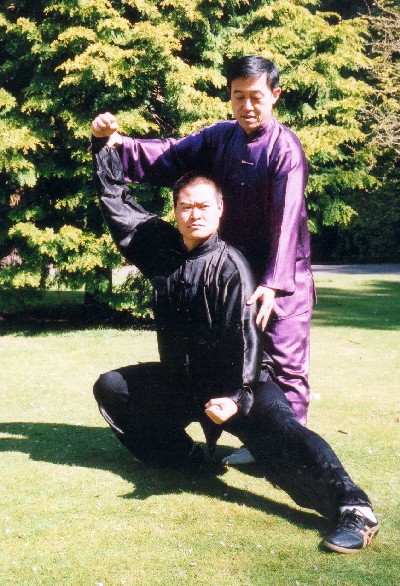
As this article shows, when you are trainging with Master Wang Hai Jun you are trainging in the traditional Chen Tai Chi lineage
This article has been published with thanks to Chen Tai Chi Ireland
Click here for Master Wang’s streaming channel