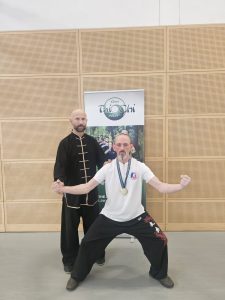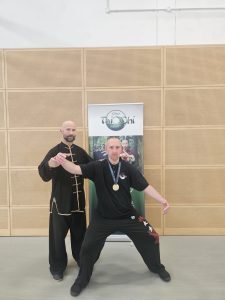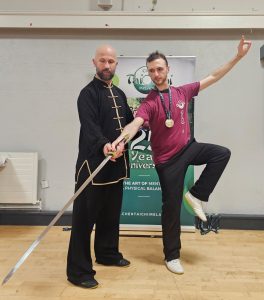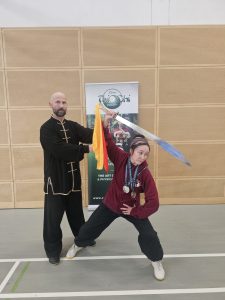
Chen Tai Chi 18 Step Form

Grandmaster Wang Haijun’s teacher – Grandmaster Chen Zheng Li, created the 18 Step Form.

The eighteen movement form was created from the Old Frame first form of Chen Style (Laojia Yi Lu).

It is only one quarter the length of the Laojia and consequently less demanding to learn. It is an excellent form to practice for the those interested in the development of good health and a stepping stone to learning the longer and more complex Old Frame (Laojia).

You can access Wang Haijun’s 18 Step Form instructional stream here.

1. Preparing Form (Qi Shi)
2. Buddha’s Warrior Attendant Pounds Mortar (Jin Gang Dao Zhui)
3. Lazily Tying Coat (Lan Zha Yi)
4. Six Sealing and Four Closing (Liu Feng Si Bi)
5. Single Whip (Dan Bian)
6. White Crane Spreads Wings (Bai He Liang Chi)
7. Walking Obliquely (Xie Xing)
8. Brushing Knees (Lou Xi)
9. Stepping Lightly (Ao Bu)
10. Hidden Thrust Punch and Whirling Upper Arms (Yan Shou Hong Quan)
11. High Pat on Horse (Gao Tan Ma)
12. Side Kick With Left Heel (Zuo Deng Yi Gen)
13. Jade Maid Works Shuttles (Yu Nu Chuan Suo)
14. Cloud Hands (Yun Shou)
15. Turn Back and Wave Double Lotus (Zhuan Shen Shuang Bai Lian)
16. Head On Blow (Dang Tou Pao)
17. Buddha’s Warrior Attendant Pounds Mortar (Jin Gang Dao Zhui)
18. Closing Form (Shou Si)

Chen Tai Chi – Training Tips

Blog by Niall O’Floinn of Chen Tai Chi Ireland school

Movement and Power

Tai Chi is an excellent way to channel your emotions and energy. Learning the basics of movement and how to use energy as power and strength.

Efficiency Of Movement

To reach a level of effectiveness in self-defense, all responsive movement must be internalized to the point where it is executed automatically. If you have to think about the movement, it is too late.

Because Taiji combines co-ordination, balance and the internalization of complex motor programs, advanced practitioners would provide excellent subjects to further investigate how the brain is involved in motor programming, exploring connections between the Prefrontal cortex (responsible for initiation and programming of motor sequences) the dorsal and ventral stratum of the basal ganglia (responsible for habit formation), and the cerebellum (responsible for balance, co-ordination and control of voluntary movement).

The way movement is controlled in the brain suggests the basal ganglia region is ‘exercised’ in Taijiquan. On a movement basis, the motor cortex sends info to the basal ganglia and cerebellum, and both send info back via the thalamus.

The overall effect of the basal ganglia on the thalamus is inhibitory, while the overall effect of the cerebellum is excitatory.

An important function of the basal ganglia is to stop (put the brakes on) unwanted movement. Taiji movement strives for perfect efficiency with absolutely no extraneous or purposeless movement – as the classics say, “no excess, no deficiency”.

Smooth, coordinated, efficient movement is a function of the balance between the inhibitory (Yin) basal ganglia and the excitatory (Yang) cerebellum systems and their communication with the motor cortex. The balanced interplay of Yin and Yang is the very definition of Taiji.

Strength And Power

In traditional terms, the power of Taiji is described as a strong and solid but also smooth, elastic and economical force. This strength is referred to as ‘internal power’ to distinguish it from ‘external’ rigid and inefficient strength of brute force or globally contracted muscles.

The strength of the energy gathered from correct Taijiquan practice is eventually obvious to the practitioner – as an expanding, solid feeling, analogous to the elastic strength of an inflated ball.

This fundamental strength is called ‘peng energy’. The ‘8 forces’ of Taiji – peng / lu / ji /an / cai / lie / zhou / kao – specifically characterize the direction and length (or duration) of different forces.

The combination of potential directions, duration’s and lengths of forces are vast and best internalized to become a natural response to an attack. By practicing the Taiji form many times following the guidelines for practice set out by an accomplished teacher, these skills become fully integrated with ones mind and body.

Old Frame (Laojia) – First Form (Yi Lu)

A listing of the Postures of Chen Family Taiji Boxing (Chen Jia Taiji Quan)

Once you have read this blog, you can click here to access Master Wang’s online Laojia Yi Lu lesson

Laojia Yi Lu is the oldest surviving of the Chen style forms. It was created from a synthesis of five of Chen Wangting’s early routines. It is used to develop the basic principles of movement, a format for teaching a student how to move correctly. It is a complex training tool and forms a framework for developing the martial skills of Chen Style Taiji. The Laojia Yi Lu is the form from which all other Taiji styles developed.

It is considered to be the foundation form for all other Taiji forms. The great Grandmasters of Chen style are said to have practised this form upwards of twenty times daily.

The 74 movement listing below was corrected by Grandmaster Wang Haijun with the invaluable assistance of Aarvo Tucker translating and making Pin Yin spelling corrections.

1. Preparing Form (Yu Bei Shi)
2. Buddha’s Warrior Attendant Pounds Mortar (Jin Gang Dao Zhui)
3. Lazily Tying Coat (Lan Zha Yi)
4. Six Sealing and Four Closing (Liu Feng Si Bi)
5. Single Whip (Dan Bian)
6. Buddha’s Warrior Attendant Pounds Mortar (Jin Gang Dao Zhui)
7. White Crane Spreads Wings (Bai He Liang Chi)
8. Walking Obliquely (Xie Xing)
9. Brushing Knees (Lou Xi)
10. Stepping Lightly (Ao Bu)
11. Walking Obliquely (Xie Xing)
12. Brushing Knees (Lou Xi)
13. Stepping Lightly (Ao Bu)
14. Hidden Thrust Punch and Whirling Upper Arms (Yan Shou Hong Quan)
15. Buddha’s Warrior Attendant Pounds Mortar (Jin Gang Dao Zhui)
16. Flinging Body (Pie Shen Quan)
17. Green Dragon Comes Out of Water (Qing Long Chu Shui)
18. Double Pushing Hands (Shuang Tui Shou)
19. Fist Under Elbow (Zhou Di Kan Quan)
20. Whirling Upper Arms (Dao Juan Hong)
21. White Crane Spreads Wings (Bai He Liang Chi)
22. Walking Obliquely (Xie Xing)
23. Flashing the Arm (Shan Tong Bei)
24. Hidden Thrust Punch and Whirling Upper Arms (Yan Shou Hong Quan)
25. Six Sealing and Four Closing (Liu Feng Si Bi)
26. Single Whip (Dan Bian)
27. Cloud Hands (Yun Shou)
28. High Pat on Horse (Gao Tan Ma)
29. Brushing the Right Foot (You Cha Jiao)
30. Brushing the Left Foot (Zuo Cha Jiao)
31. Kicking With the Left Heel and Following (Zuo Deng Yi Gen)
32. Forward Twist Step (Qian Tang Ao Bu)
33. Punch the Ground (Ji Di Chui)
34. Kicking with Two Heels (Ti Erh Qi)
35. Protecting the Heart (Hu Xin Quan)
36. Whirlwind Foot (Xuan Feng Jiao)
37. Kicking with the Right Heel and Following (You Deng Yi Gen)
38. Hidden Thrust Punch and Whirling Upper Arms (Yan Shou Hong Quan)
39. Small Capturing (Xiao Qin Da)
40. Embracing Head and Pushing Mountain (Bao Tou Tui Shan)
41. Six Sealing and Four Closing (Liu Feng Si Bi)
42. Single Whip (Dan Bian)
43. Forward Trick and Backward Trick (Qian Zhao Hou Zhao)
44. Parting the Wild Horse’s Mane (Ye Ma Fen Zong)
45. Six Sealing and Four Closing (Liu Feng Si Bi)
46. Single Whip (Dan Bian)
47. Jade Maid Works Shuttles (Yu Nu Chuan Suo)
48. Lazily Tying Coat (Lan Zha Yi)
49. Six Sealing and Four Closing (Liu Feng Si Bi)
50. Single Whip (Dan Bian)
51. Cloud Hands (Yun Shou)
52. Waving Double Lotus Shake Foot and Stretch Down (Bai Jiao Die Cha)
53. Golden Rooster Stands on One Leg (Jin Ji Du Li)
54. Whirling Upper Arms (Dao Juan Hong)
55. White Crane Spreads Wings ( Bai He Liang Chi)
56. Walking Obliquely (Xie Xing)
57. Flashing the Arm (Shan Tong Bei)
58. Hidden Thrust Punch and Whirling Upper Arm (Yan Shou Hong Quan)
59. Six Sealing and Four Closing (Liu Feng Si Bi)
60. Single Whip (Dan Bian)
61. Cloud Hands (Yun Shou)
62. High Pat on Horse (Gao Tan Ma)
63. Crossed Feet (Shi Zi Jiao)
64. Punch the Groin (Zi Dang Chui)
65. Ape Touches Fruit (Bai Yuan Xian Guo)
66. Six Sealing and Four Closing (Liu Feng Si Bi)
67. Single Whip (Dan Bian)
68. Nimble Dragon Descends (Que Di Long)
69. Stepping Forward to Form the Seven Star (Shang Bu Qi Xing)
70. Stepping Back to Ride the Tiger (Tui Bu Kua Hu)
71. Turn Back and Wave Double Lotus (Zhuan Shen Shuang Bai Lian)
72. Head On Blow (Dang Tou Pao)
73. Buddha’s Warrior Attendant Pounds Mortar (Jin Gang Dao Zhui)
74. Closing Form (Shou Si)

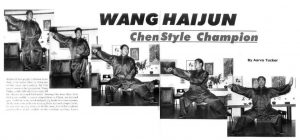
Wang Haijun – Chen Style Champion by Aarvo Tucker

Relatively few people in Britain know that, in our midst, there is living one of the most outstanding Tai Chi practitioners of its generation. Wang Haijun, while still only thirty years old has already accomplished much. Amongst his more than forty first place medals in major competitions in China, are national gold medals in form, sword and pushing hands two years running. At the same time as he was winning these national competitions, he was also training others to do the same, two of his students gaining first place medals in the national pushing hands championships.

And so how did he accomplish so much so fast? Well, first of all, he started at a young age with one of the most highly regarded teachers in China, Chen Zhenglei. Wang’s father was very keen on martial arts, and seeing the same interest in his young son, he arranged, through a friend, who was close friends with Chen Zhenglei, for his son to live at Chen’s house in Chen village. From the age of nine Wang Haijun had high quality daily instruction which, in addition to natural talent, and appetite for hard work, and the time he set aside for his daily training, has resulted in his incredible achievements so far.

Wang estimates that 80-90% of the Chen Villagers practice Taijiquan. Since the area around Chen Village is mainly agricultural, often, after working in the fields, people would practice the form a few times, to stretch their legs and give their bodies and minds a sense of well-being. With his main activity being to learn Tai Chi, Wang was on a much moer intensive training schedule—three times a day, the first session starting at 5:30am until breakfast at 7 o’clock. Then he was off to school, coming home for lunch before going back to school in the afternoon. After school, he practiced from 4 until 6pm, and then had dinner. He would let his food settle for 30-40 minutes and then practice in the evening for another couple of hours.

In those days, before Taijiquan had the degree of government sponsorship that it now has, his teacher, Chen Zhenglei, worker as a salesman of electrical machinery, which required that he sometimes be away on business. However, when he was at home, he generally gave instruction in the afternoon training session, sharing the finer points of the form. For the first six years of his training Wang Haijun focused solely on the Chen first form, not doing any pushing hands, applications or weapons until much later. These six years were spent form training to help to build a strong foundation. He feels that the kind of strength and movement that are developed in Tai Chi are hard to describe in words and must be experienced through long practice which facilitates a deep body understanding. When this foundation work is done the ‘root becomes strong, the internal Qi becomes full’ and then the other forms are easy and simple.

Nowadays with the opening of China and the greater exposure of Chen style Tai Chi, many people from around the country, and indeed from around the world, go to the origin of Tai Chi to seek out instruction. However twenty years ago this was not the case. In the early to mid eighties, there were often just few outsiders, and the practice sessions were often just a handful of people training. In such an environment, with that amount of individual attention and more intense time spent with the teacher, growing up almost as part of Chen Zhenglei’s family, the hopes and expectation for Wang’s Tai Chi development were high. At the age of sixteen he went off to the Wuhan Sports Institute as a specially admitted student, and after graduation he got assigned a work unit, which was the Pingdingshan Martial Arts Academy where he was reunited with Chen Zhenglei who was now the head of the academy.

It was around this time that he began his career in Taijiquan competitions. In 1992 he entered the national pushing hands competition and got a first place medal. During 1993 he traveled with his teacher to several countries giving demonstrations and assisting in workshops. In 1994 he won the national pushing hands championship in the 80 kilogram weight division. In 1996 he also won gold medals in national championships, and then the pinnacle of his career in competitions was two consecutive years (1997-1998) winning the three categories of Taiji form, sword and pushing hands in the biggest national tournament which brought him the title of overall champion.

In the martial arts world there are many tournaments, the significance and standards of which vary widely. The names may be misleading. The titles national and international maybe bandied about without it meaning very much. In some tournaments there may only be a few contestants in a particular category or weight division—with only three contestants, each will get a medal regardless of performance. In these tournaments, Wang was against the best of the best—people who were selected from each province to vie for most important national titles.

At the same time of this personal success in 1997, he established a martial arts school in Zhengzhou, the capital of Henan province. The team he trained and led into competition was the highest scoring of all teams in a 1998 national tournament, and he trained many students to good results; two of whom won national pushing hands competitions at 52 kgs in 1997 and 65 kgs in 1998. These students express great devotion to him, and speak of Wang as a highly accomplished master of the art, who remains a quiet-spoken, dignified and direct man—someone who is exemplary in the personal qualities of the traditional Chinese martial artist. One of his students quoted the Chinese phrase: ‘Being able to eat the bitterest of the bitter, one can be a man above men’. Rectitude, humility, courtesy are what stuck me when I first met him, as apparent as his serous attitude toward Taijiquan. Not one for self-promotion or talking about himself, I was glad that his wife was willing to tell me things about him.

His wife is an accomplished wushu person in her won right, having gained national gold medals in straight sword, broadsword, and two person routines. She worked for many years as a wushu coach, and is called Jia Laoshi by Wang’s students. Their daughter, a lively, bright-eyes girl of five has the advantages of strong genetic inheritance and excellent instruction available, but her mother, having gone through the hardship of training from a very young age, getting up early in all kinds of weather to train while friends and classmates could sleep in, wants her daughter to have an easier childhood. Wang, on the other hand, hopes she will earn something of the art which he has spent most his life practicing.

Wang Haijun talks about some attributes that people doing Taiji and all athletes must develop: stamina and strength are developed through form practice, explosive power through more specialized training, such as pole shaking exercises and single movement drills, and flexibility which he considers to be not as important as in some other sports, but which is developed gradually through form practice. As to the question of weight training to supplement Taijiquan training, Wang states that if you can do it in a relaxed way, some of that type of training should be all right.

In 1997 the Chinese martial arts council held an important conference to study and discuss pushing hands competition rules. Top Taiji teachers and competitors from around the country were invited to attend and contribute. Wang was one of the participants in the conference and mentioned that one of the main topics of discussion was about which techniques would be allowed. Some of the decisions they arrived at were that the traditional eight techniques of Taiji—peng, lu, ji, an, cai, lie, zhou, kao would be allowed, but for safety’s sake only the sides and not the points of the elbows may be used; the use of the legs must be limited to techniques such as tripping in which the feet stay on the ground (no large sweeping/kicking movements of the legs).

In Wang’s training in Chen village, and in some of the regional competitions, they did moving step pushing hands: moving forwards and back in a pattern. He believes that training in this way makes it more likely to adhere to the Taiji principles of avoiding the opponents force and not resisting directly. The downside however is that there tends to be more injuries. The national competitions have now adopted the fixed feet rules, which he feels are less ideal for displaying Taiji principles of engagement but result in fewer injuries.
With the large Chen style curriculum to practice, Wang says his own practice still focuses on the Laojia Yilu—the old first form—and then the second form (Pao Chui) and the ‘new form’ versions of these two. With respect to the various weapon forms; by practicing them once a week he gets the footwork and body movement training from them, but feels if the basic form is good then the weapons will be correspondingly good. He quoted a famous dictum: ‘Practice the form and not just techniques’.

In his teaching, he puts quite a bit of emphasis on the Silk Reeling Exercises as a ways of instilling the basic movement principles of Taijiquan. They are relatively new development in the history of Chen style, but are used by many well-known teachers. Next he generally teaches the Laojia Yilu (the old style first form), which he says was traditionally used as a first test of prospective students to see how seriously they practiced and to see about their character. It is also the main gongfu building form—the foundation for the rest of the system. Wang recognizes that people of today live in a wholly more complex society, with a greater number of distractions, entertainments, choices, and much more information available, and much less time with their instructor than in earlier times. Consequently he teaches students more quickly, feeding them new movements at a faster rate. When he was learning he accepted whatever his teacher taught, and at whatever pace, however slowly. People nowadays would not generally have the patience for that, but when you see the result in Wang Haijun’s level of skill, it is difficult not to appreciate the ‘slow cook’ method.

Wang Haijun - Chen Tai Chi Champion

From the original publication

Seminar in France

Hésingue, France.

It was an international workshop including local students and participants coming from Paris, Germany, England and Portugal.

Master Wang Haijun delighted us with an invigorating workshop of Tui Shou and

movement refinement on Lao Jia Er Lu (Cannon Fist).

The emphasis was heavily biased towards Tuishou (Push Hands)

We all had the opportunity to touch hands with each other under the guidance of Master

Wang.

More excitingly was that everyone had the chance to experience Tuishou with Wang Haijun and feel his softness and power.

The purpose was to focus on ‘listening’

At first through the double hands vertical circle exercise. ‘Give me your arms’ and ‘let me guide you’.

Then by trying to keep elasticity in the double hands opening/closing exercise.

And further going through all the single and double hands fixed step Tuishou exercises focusing on Peng, Lu, Ji, An.

Through this progression in approaching Tuishou everyone improved their ‘perception’and it was highly interesting to ‘feel’ so many different people. We did Tuishou all Saturday afternoon and most of Sunday, of which we overran by half an hour. But Shifu thought it was important that we finish on Cai-Lie-Zhou-Kao training which everyone was more than pleased with.

We are so grateful for Shifu’s high investment and hard work with us. He certainly opened a new interesting door to many students.

It was inspiring!

Heidi

US Seminar

The March, western Massachusetts training included instruction for Pao Chui and for Xinjia Yilu. As in all of Wang Haijun’s trainings warm-ups replicate sections of the focus forms. In this weekend warm-ups there are many hand circles: hands with fingers pointing up or integrated with the arms as if playing with water, or “fish hands” in which the fingers flash like a fish. The purpose of these circles in the new form is to see the circles on the outside of the body. In Laojia circles and changes of direction are not as visible.

Training in the traditional Chinese manner requires many repetitions to acquire body memory and correctness of form, and in our training, we repeat sections again, again, and again. Training is not about how many forms we have completed but rather how well we can execute the patterns on our own, and can we start to feel the form’s intent internally. Do we feel connected?

Throughout the weekend Wang reminds us of the foundational elements of Taiji. And this weekend there was particular emphasis on connection. One of the examples Wang shared is a connection made while breathing. As we breathe in the chest expands forwards and outwards and simultaneously the chest connects to the ming men (the gate at the kidney area in the back) which moves outwards at the same time in connection with the chest. The chest and ming men are connected and this is more noticeable with expansion as we breathe in.

This weekend we heard “the muscles drop, the bones lift-up”. Feel the skeleton lift with erectness as the muscles relax and sink. So many reminders: skeleton and bones lift-up, muscles sink to the earth.

More reminders to focus on “the bottom sinking” without hiking the bottom. The bottom sinks but is not hidden. Drop, “like sitting on a chair”.

Connection, connection: shoulders to hips, knees to elbows, feet to hands. Sides of the body to the centre; chest to the ming men. Again, again, again we are reminded.

We leave exhausted and exhilarated.

Margery

Tai Chi for Entrepreneurs

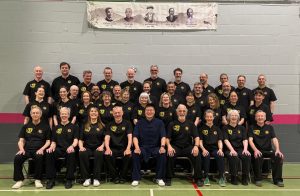
I recently passed a personal milestone of training in Chen Style Tai Chi for 21 years, pictured above with Sifu Niall O’Floinn and Grandmaster Wang Haijun at the Chen Style Tai Chi Ireland school.

Anyone I mention Tai Chi to thinks the have a vague idea what it is… a bit ‘airy’, waving arms around and it is supposed to be good for old people! There is a bit more too it than that.
There are several well-known styles which have varying degrees of physical difficulty. The style I study – Chen Style, is physically quite demanding, but all styles have significant benefits regardless of your age.


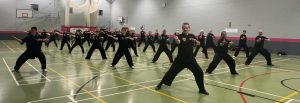
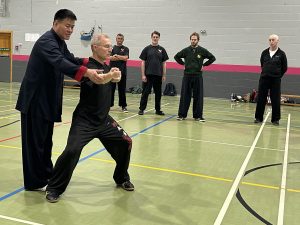
Grandmaster Wang Haijun leading the seminar in Galway

Most articles/blogs you read on Tai Chi focus on the benefits in aging. For me Tai Chi has been a key part of my entrepreneurial life, so on this milestone I thought I’d write a blog on how I felt it has been a benefit in the life of an entrepreneur. Here are some of the key points:

1. Stress Reduction: Every entrepreneur and anyone in business/business owner knows they need to manage stress. It can actually kill you! Tai Chi involves slow, flowing movements and deep breathing, which can help reduce stress and promote relaxation.

2. Improved Focus and Mental Clarity: Practicing Tai Chi can help enhance mental clarity and concentration. This is especially useful for entrepreneurs who are leading a team, building a business, sourcing funding, making critical decisions and at the same time need to stay focused on their business goals.

3. Enhanced Physical Fitness: Tai Chi is a form of low-impact exercise that can improve balance, flexibility, and strength. Although movements are slow, studies have found that thirty minutes of Tai Chi equates to thirty minutes of jogging. For the dedicated desk worker, Tai Chi can be practiced anywhere with no equipment necessary. You only need the space of twice your shoulder width to practice!

4: Increased Energy Levels: Regular Tai Chi practice can boost energy levels and combat fatigue. Entrepreneurs often work long hours and need to maintain their energy to stay productive and alert.

5. Better Posture and Body Awareness: Chen-style Tai Chi emphasizes proper body alignment and balance, which can lead to improved posture. Entrepreneurs who spend a lot of time sitting at a computer may develop poor posture, leading to discomfort and pain.

6. Stress Resilience: As distinct from managing current stress levels, Tai Chi can help individuals develop stress resilience, allowing them to cope with challenging situations more effectively. Entrepreneurs often encounter setbacks and high-pressure situations, and the ability to remain calm and resilient is valuable.

8. Mind-Body Connection: Chen-style Tai Chi emphasizes the mind-body connection, helping individuals become more aware of their bodies and their physical and emotional states. This self-awareness can be valuable for entrepreneurs in managing their emotions and stress.

9. Time for Self-Care: Entrepreneurs often neglect self-care due to their demanding schedules. Practicing Tai Chi provides a dedicated time for self-care and promotes work-life balance.

10. Long-Term Health Benefits: Regular Tai Chi practice has been associated with various long-term health benefits, including improved cardiovascular health, improved bone density, reduced risk of falls in older age (old age eventually came into this blog!), and better overall well-being. Entrepreneurs who invest in their health are likely to have more energy and longevity in their careers.

It’s important to note that the benefits of Chen-style Tai Chi, like any exercise or wellness practice, may vary from person to person. To experience these advantages, consistency and regular practice are key.

For me, I have been extremely lucky in my Tai Chi life. Since my first day I have had two amazing teachers in Galway. Sifu Niall O’Floinn and Grandmaster Wang Haijun with Chen Tai Chi Ireland school.

Niall O’Floinn was my introduction to Tai Chi when I started by doing a ten-week class. I have now been attending that class weekly since 2002! It takes a diligent, knowledgeable and inspirational teacher to inspire students to keep coming to class for decades!

The school has been under the tutelage of Grandmaster Wang Haijun since 2002 and I have been participating in quarterly seminars with him in Galway since just after I started in the school. Grandmaster Wang is one of the worlds leading Chen Style teachers who was three times all China champion himself and has trained ten subsequent All China Champions. That this level of teaching is available in Galway is nothing short of amazing.

When I started, I was going to the weekly class and ‘doing a bit’ now and then outside of class. Now as well as classes and seminars I have my own daily practice.

Entrepreneurs globally interested in incorporating Tai Chi into their routine can consider joining a local class or you can:

Stream instructions here with Grandmaster Wang Haijun

Or book online class with Niall to get started.

For entrepreneurs/business owners/professionals/everyone in Galway or Ireland I highly recommend contacting Chen Tai Chi Ireland and booking a class.

For Tai Chi it is never too late to start. It is also never too early.

Ollie