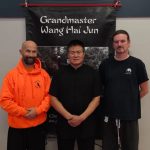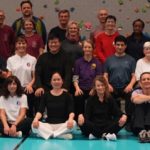

The March, western Massachusetts training included instruction for Pao Chui and for Xinjia Yilu. As in all of Wang Haijun’s trainings warm-ups replicate sections of the focus forms. In this weekend warm-ups there are many hand circles: hands with fingers pointing up or integrated with the arms as if playing with water, or “fish hands” in which the fingers flash like a fish. The purpose of these circles in the new form is to see the circles on the outside of the body. In Laojia circles and changes of direction are not as visible.
Training in the traditional Chinese manner requires many repetitions to acquire body memory and correctness of form, and in our training, we repeat sections again, again, and again. Training is not about how many forms we have completed but rather how well we can execute the patterns on our own, and can we start to feel the form’s intent internally. Do we feel connected?
Throughout the weekend Wang reminds us of the foundational elements of Taiji. And this weekend there was particular emphasis on connection. One of the examples Wang shared is a connection made while breathing. As we breathe in the chest expands forwards and outwards and simultaneously the chest connects to the ming men (the gate at the kidney area in the back) which moves outwards at the same time in connection with the chest. The chest and ming men are connected and this is more noticeable with expansion as we breathe in.
This weekend we heard “the muscles drop, the bones lift-up”. Feel the skeleton lift with erectness as the muscles relax and sink. So many reminders: skeleton and bones lift-up, muscles sink to the earth.
More reminders to focus on “the bottom sinking” without hiking the bottom. The bottom sinks but is not hidden. Drop, “like sitting on a chair”.
Connection, connection: shoulders to hips, knees to elbows, feet to hands. Sides of the body to the centre; chest to the ming men. Again, again, again we are reminded.
We leave exhausted and exhilarated.
Margery