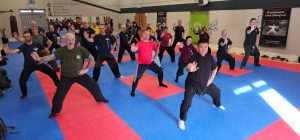
This years UK Easter Camp focused on the Xin Jia Yi Lu form, which often translated as “New Frame First Routine.”
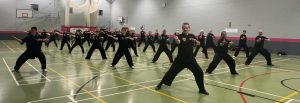
Master Wang leads the group in Xin Jia
This form was developed by Chen Fake and is based on the traditional With 83 postures it was a challenging week both physically and mentally, as there was a lot to learn! However, Master Wang led thirty of this long term students through the process and made sure it was fun as well as a challange.
Xin Jia is one of the most dynamic and expressive systems of movement in the Chen tradition. Developed and refined through the Chen family lineage, the form combines softness and relaxation with explosive power, spiralling energy, and deep internal structure.
Xin Jia Yi Lu is a complex form. The movements coil and unwind continuously, the body rotates through the waist and dantian, and periods of calm slowness are suddenly interrupted by bursts of fajin (explosive release of power). Yet beneath the complexity lies a clear purpose: to train the body to move as one connected unit while cultivating balance, sensitivity, rootedness, and internal force.
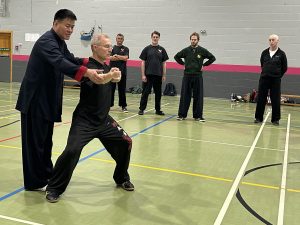
Master Wang Correcting Postures
Xin Jia Yi Lu preserves much of the martial DNA of traditional Chen training. Circular silk-reeling energy — known as chan si jin — is present throughout every posture. The practitioner must connect the feet to the legs, the waist to the torso, and the arms to the fingertips in one uninterrupted chain of movement.
A defining characteristic of Xin Jia Yi Lu is the alternation between opening and closing, fast and slow, soft and hard. This reflects a core principle within Daoist internal arts: opposites are not in conflict, but in balance. A posture may begin softly and slowly, then suddenly release energy before returning to stillness again. Over time, the practitioner develops not only physical coordination but also calmness, patience, and heightened body awareness.
As mentioned at the start, training the form is physically demanding. Deep stances strengthen the legs and hips, spiralling motions mobilise the spine and joints, and coordinated breathing encourages relaxation under pressure. Many long-term practitioners describe Xin Jia Yi Lu as a complete system of movement training — simultaneously martial art, meditation, mobility practice, and method of cultivating internal awareness.
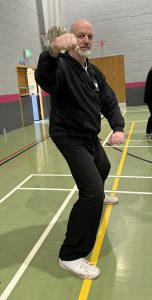
Traditionally, students spend years refining the first routine before progressing further, as had the group that attended the camp. The ultimate goal is not merely memorisation of choreography, but embodiment of principles. Every repetition reveals deeper levels of timing, structure, and of course, intent.
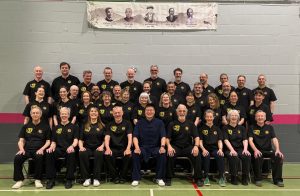
Xin Jia Group Photo
Chen Style Tai Chi New Frame – Xin Jia – Link to Video Tutorial
One Routine
List of Movements
第一段( First Section )
1.预备式 Preparation Posture
2. 金刚捣碓. Buddhist Warrior Pounds Mortar
3. 懒扎衣. Lazy about Tucking the Robe
4. 六封四闭 Six Sealing and Four Closing
5. 单鞭 Single Whip
6. 第二金刚捣碓. Second Buddhist Warrior Pounds Mortar
7. 白鹤亮翅. White Crane Spreads Wings
8. 斜行拗步 Twisted Diagonal Step
9. 初收. First Closing
10. 前膛拗步. Twisted Wade Forward
11. 第二斜行拗步. Second Twisted Diagonal Step
12. 再收. Second Closing
13. 前膛拗步. Twisted Wade Forward
14. 掩手肱捶. Covering Hand Punch
15. 第三金刚捣碓. Third Buddhist Warrior Pounds Mortar
第二段 ( Second Section)
16. 撇身捶. Leaning Punch
17. 青龙出水. Black Dragon Emerges from Water
18. 双推手. Push with Both Hands
19. 三换掌. Switch the Palms Three Times
20. 肘底看捶. Fist Under the Elbow
21. 倒卷肱. Roll the Forearms Backwards
22. 退步压肘. Press the Elbow on a Backward Step
23. 中盘. Middle Winding
24. 白鹤亮翅. White Crane Spreads Wings
25. 斜行拗步. Twisted Diagonal Step
26. 闪通背. Fan the Back
27. 掩手肱捶. Covering Hand Punch
28. 大六封四闭. Lage Frame Six Sealing and Four Closing
29. 单鞭. Single Whip
30. 云手. Wave Hands
31. 高探马. High Pat on Horse
第三段(Third Section)
32. 右擦脚. Right Toe Kick
33. 左擦脚. Left Toe Kick
34. 转身左蹬一跟. Turn Around and Stomp Kick
35. 前膛拗步. Wade Forward on Twisted Steps
36. 击地捶. Punching the Ground
37. 二起脚(踢二起)Double Flying Kick
38. 护心捶(兽头式)Protecting Heart Punch
39. 旋风脚. Tornado Kick
40. 右蹬一跟. Right Stomping Kick
41. 掩手肱捶. Covering Hand Punch
第四段 (Fourth Section)
42. 小擒打. Small Posture Grappling Strike
43. 抱头推山. Hold the Head and Push the Mountain
44. 三换掌. Switch the Palms Three Times
45. 六封四闭. Six Sealing and Four Closing
46. 单鞭. Single Whip
47. 前招. Cover the Front
48. 后招. Cover the Back
49. 野马分鬃. Wild Horses Part Mane
50. 大六封四闭. Large Posture Six Sealing and Four Closing
51. 单鞭. Single Whip
第五段 (Fifth Section)
52. 双震脚. Double Stomping
53. 玉女穿梭. Fair Lady Works at Shuttles
54. 懒扎衣. Lazy about Tucking the Robe
55. 六封四闭 Six Sealing and Four Closing
56. 单鞭 Single Whip
57. 云手 Wave Hands
58. 双摆脚. Double Lotus Kick
59. 跌岔. Falling Split
60. 金鸡独立. Golden Rooster Stands on One Leg
61. 倒卷肱. Roll the Forearms Backwards
62. 退步压肘. Press the Elbow on a Backward Step
63. 中盘. Middle Winding
64.白鹤亮翅. White Crane Spreads Wings
65. 斜行拗步. Twisted Diagonal Step
66. 闪通背. Fan the Back
67. 掩手肱捶. Covering Hand Punch
68. 大六封四闭. Large Posture Six Sealing and Four Closing
69. 单鞭. Single Whip
70. 云手. Wave Hands
71. 高探马. High Pat on Horse
第六段 ( Sixth Section)
72. 十字单摆脚. Cross Single Lotus Kick
73. 指裆捶. Pinch the Groin
74. 白猿探果. White Ape Reaches for Fruits
75. 小六封四闭. Small Posture Six Sealing and Four Closing
76. 单鞭. Single Whip
77. 铺地锦. Cover the Ground with Silk
78. 上步七星. Step Up with Seven Star Punch
79. 退步跨虎. Step Back and Mount the Tiger
80. 转身双摆莲. Turn Around with Double Lotus Kick
81. 当头炮. Cannon Fist Right in the Face
82. 金刚捣碓. Buddhist Warrior Pounds Mortar
83. 收势. Closing Posture